Live System
MetaMiner
Competitive ad intelligence: the angles your rivals are spending on, surfaced daily.
MetaMiner reads the ads your competitors keep paying to run. It mines Meta's public Ad Library, sorts by what has been live longest (an ad that survives is an ad that converts), detects the recurring hook patterns, and tells you which angles are heating up and which are burned out. No manual scrolling, no guesswork.
7 min read
View the live briefing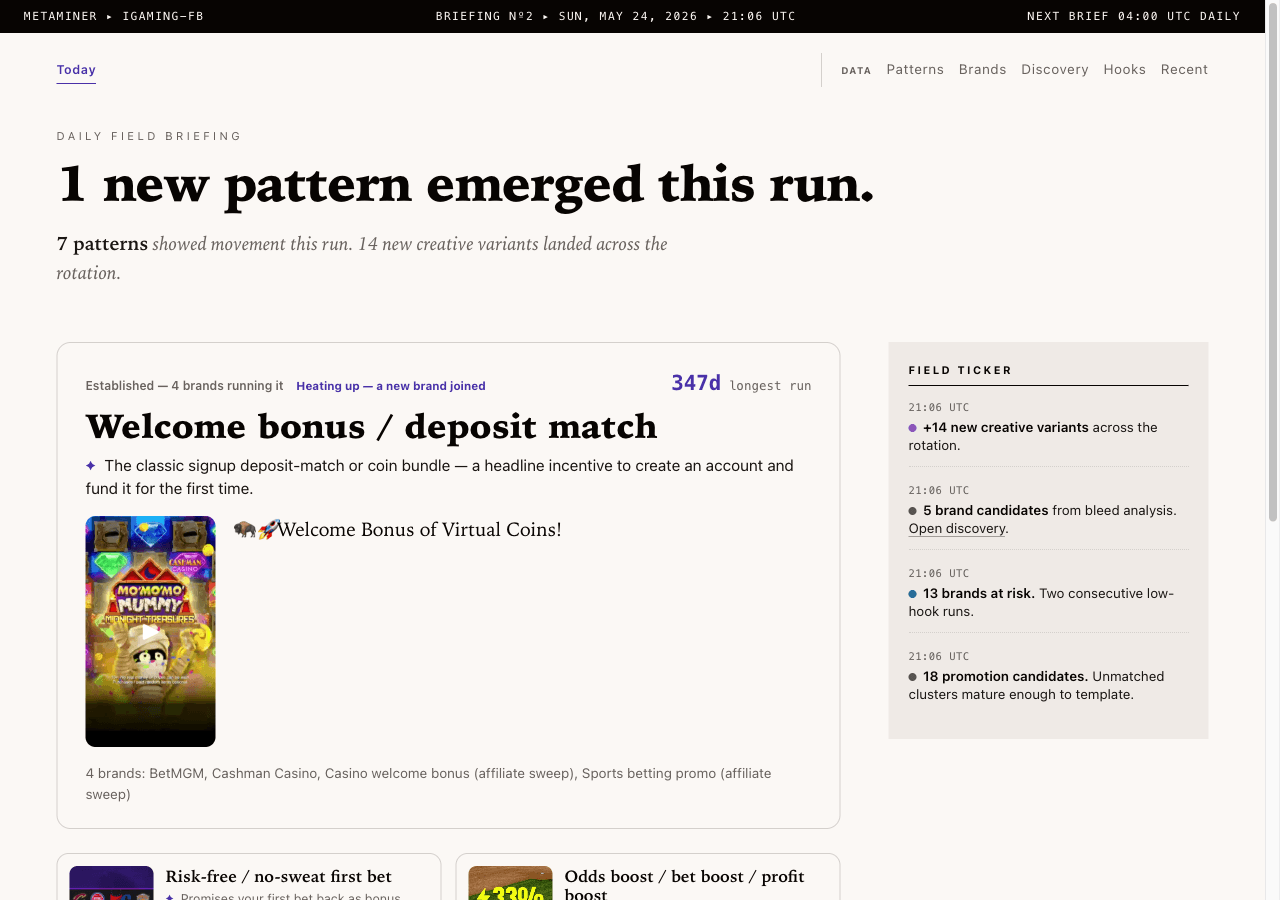
The Problem
Competitor ad analysis, when it happens at all, happens by hand. Someone scrolls the Ad Library on a Friday, eyeballs a few rivals, and jots down what looks interesting. By the next time anyone looks, the market has moved and the notes are stale.
The signal that matters most is invisible to the naked eye: ad spend. Anyone can launch a creative. The ones that stay live for weeks are the ones that convert, because nobody keeps paying to run an ad that does not. Longevity is the vote. But you cannot see longevity by glancing at a feed; you have to track every ad over time.
And the hook is everything. In direct response, the first line of the ad is engineered to stop the scroll. Miss which hooks your competitors are scaling and you are guessing at the single decision that drives the whole funnel.
What it mines
MetaMiner pulls from Meta's public Ad Library, the same source any regulator or competitor can see, and turns a noisy feed into a ranked signal.
Longest-running ads
Sorted by how long each ad has been live. An ad running 300 days is a proven winner; a brand-new one is an unvalidated guess. Longevity is the spend signal.
First-line hooks
The opening line of every ad, captured verbatim. In direct response that first sentence is the hook, built to stop the scroll. No OCR guessing required.
Creative variants
How many versions of an angle a brand is testing and how fast they rotate. Heavy rotation means active spend and live iteration.
Started-on dates
When each campaign went live, so a sudden burst of new creative from a competitor is visible the day it happens.
Brand coverage
Which competitors are scaling, which are pulling back, and which new brands just entered the auction.
At-risk and burned angles
Patterns a brand has tried and dropped repeatedly are flagged as burned, so you never waste budget reviving a dead angle.
How it works
MetaMiner runs a headless miner against Meta's Ad Library on a daily schedule. It pulls the top active ads per tracked brand, sorted by longest-running, and grabs the hook copy, creative variants, and started-on dates. Because the Ad Library is public, this needs no special access: it sees exactly what the regulator and the competition see.
Raw hooks pass through deterministic pattern detection: lexical template matching first, then clustering of whatever does not match a known template. No black-box embeddings, because the same input must produce the same signature on every run. A pattern is a reproducible thing, not a vibe.
Each pattern carries a lifecycle. New patterns are flagged the run they appear. Converging patterns gain momentum as more brands adopt them. A pattern needs two consecutive misses before it retires, so one noisy scrape cannot kill a real signal. A signature retired and revived again and again gets tagged burned.
The output is a daily field briefing: which patterns moved, which brands are at risk, which new angles are maturing toward a template, and the actual hook copy behind each. Read it in two minutes, act the same morning.
Live today
MetaMiner is running live on the US iGaming market right now, tracking licensed sportsbook and casino operators including DraftKings, Hard Rock Bet, Fanatics, BetMGM, and Cashman Casino. The briefing refreshes daily and is published as a standalone dashboard.
A typical run surfaces the active patterns (welcome-bonus and deposit-match, risk-free first bet, odds boost), flags the brands at risk of churning a creative, and lists the new angles maturing toward a recognised template. Every figure traces back to a real ad in the Library.
It is not a mock. The dashboard you can open below is generated by this pipeline, on real Ad Library data, on a daily cron.
What you can do with it
- 01
Clone the angles that work
When a competitor scales a hook for 300 days, that is a validated angle. Borrow the structure, not the wording, and skip the months of testing they already paid for.
- 02
Spot a rival's new offer the morning it ships
A burst of new creative shows up in the next day's briefing. You react while it is fresh, not after it has saturated.
- 03
Stop reviving dead angles
Burned patterns are flagged. If three competitors tried and dropped an angle, you do not spend budget rediscovering why.
- 04
Brief your creative team with evidence
Hand your team ad-spend-validated angles instead of opinions. The brief writes itself from the briefing.
Want this on your market?
MetaMiner can track any competitor set in any vertical Meta's Ad Library covers. Tell us your market and we will point it at your rivals.